“Solidarity at Scale: Converging our Movements for System Change”
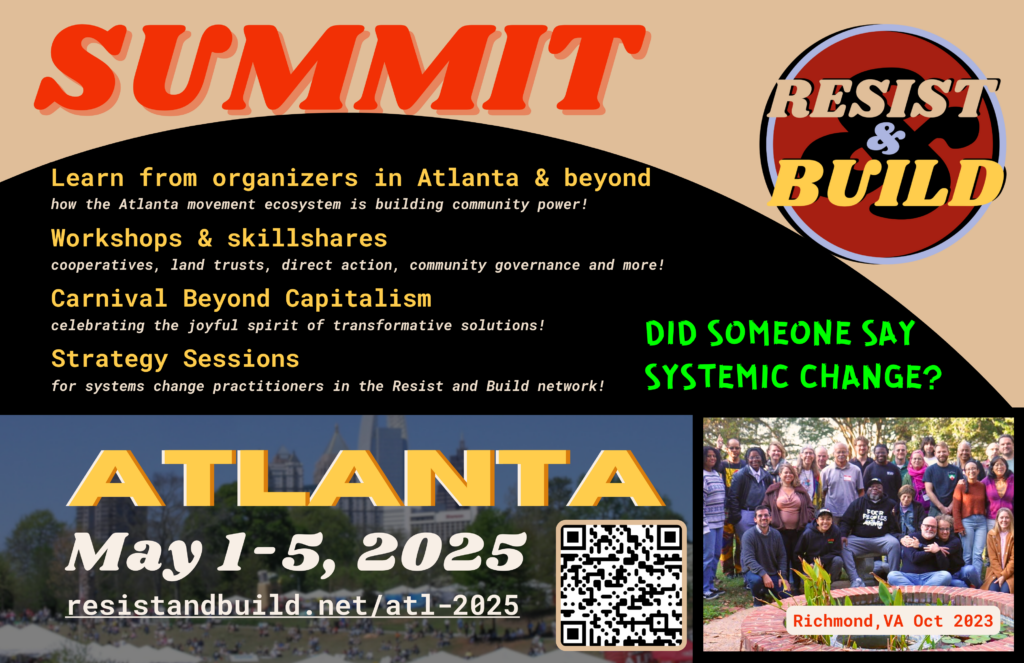
More than 300 people gathered in Atlanta between May 2nd and 5th, 2025 to explore post-capitalist futures and forge connections between resistance movements and alternative institutions through strategy sessions, workshops, plenaries, and a “Carnival Beyond Capitalism.” Check out this page to learn more about what we accomplished.
The Critical Moment
As we confront interlocking crises—environmental degradation, deepening inequality, resource extraction from the Global South, rising fascism, war, genocide, and U.S.-led corporate imperialism—urgent, transformative responses are needed. The continued dominance of the two-party capitalist system further emphasizes the need to strengthen our independent movements for systemic change. This gathering is a vital opportunity to deepen our networks, sharpen our strategies, and amplify collective power toward the post-capitalist futures that people and the planet urgently need.
The Resist and Build process bridges the gap between resistance movements and initiatives to build a transformed system, recognizing that resistance without a clear vision risks mere reform, while building alternatives without roots in resistance risks exclusion and co-optation.
About the Summit
Reserved Access Events Summary
- Strategy Sessions: We sharpened our analysis toward a clear collective strategic orientation.
- Action Circle Commitments: We made commitments to following through on collaborative efforts.
Public Events Summary
See Detailed Schedule for confirmed activities. The public summit pass included everything from 7pm Friday to 10pm Sunday.
- Workshops, Panels, and Plenaries — May 2nd, 3rd, and 4th: Revolutionaries and solutionaries shared knowledge and skills related to resistance, built post-capitalist alternatives, and tended a transformative culture of care and connection. Topics explored system change, organizing strategies, collective governance, shared ownership, and more.
- May 2nd Location: The MURPH
- May 3rd Location: Morehouse Leadership Center
- May 4th Location: The Wren’s Nest
- Carnival Beyond Capitalism — Sunday, May 4th: A Portal to Play, Power, and Possibility Step out of capitalism for a day and into a vibrant, liberated zone of radical abundance, mutual aid, and collective dreaming. This day-long festival celebrated creativity, cultural expression, and revolutionary possibilities through art, performances, skill-sharing, open conversations, communal activities, and diverse food vendors. More than a festival—it was a temporary autonomous zone where we practiced the world we want to see. We connected, conspired, and co-created spaces of collective liberation, unleashed our wildest visions, and built power together. Together, we crafted a living example of post-capitalist joy, where everyone was both creator and participant. We broke bread, shared skills, made art, built power. A carnival of radical play, connection, and transformation.
- Location: The Wren’s Nest
- Fun Social Activities: We gathered to build culture, connection, and relationships to support our long haul organizing.
Summit Schedule At-A-Glance
See Detailed Schedule for archive of confirmed activities
Friday, May 2
Strategy Sessions, 9 AM – 6 PM (Update: Strategy sessions are at capacity. Pre-approved attendees only.)
Welcome Plenary, Evening (Public event)
Saturday, May 3
Workshops, Plenaries, and Tours (Public events)
Sunday, May 4
Carnival Beyond Capitalism (Public event)
Workshops, Plenaries, and Tours (Public events)
Monday, May 5
Strategy Sessions, 9 AM–3 PM (Update: Strategy sessions are at capacity. Pre-approved attendees only.)
Affiliated Events
May 29-June 1, 2025 – World Social Forum – Montreal, Canada and affiliated events around the world
Date TBD – Asset-Based Community Development and Systems Change – ONLINE
March 23 – Atlanta’s Legacy of Struggle and Vision for a Just Future discussion with Jessica Gordon-Nembhard and local Atlanta organizers – ONLINE
March 22 – Shaping Change Facilitator Festival – ONSITE in CHICAGO
Organizers
A national Summit Planning Circle included representatives from American Friends Service Committee (AFSC), Black Nashville Assembly, Boston Impact Initiative, Kola Nut Collaborative, Living World Studios, May First Movement Technology, Next System Studies (NSS), Participatory Budgeting Project, People’s Network for Land and Liberation, Shareable, The Democracy Collaborative, TMH Financial Solutions, US Solidarity Economy Network, Wellspring Cooperative.
A local Atlanta Host Circle included representatives from American Friends Service Committee (AFSC), Community Development & Entrepreneurship Law Clinic at Georgia State University College of Law, Community Movement Builders, EndState ATL, The Guild, HiveMind, Malcolm X Grassroots Movement, Movement for Black Lives (M4BL), The MURPH, Organization for Human Rights and Democracy (OHRD), and Project South.
Sponsors
Beyond Capitalism Sponsors
The Multi-Use Radical People’s Hall (MURPH)
Building the Future Sponsors
Progressive Technology Project
Resisting Domination Sponsors
Morehouse College – International Comparative Labor Studies
Next System Studies Association Initiative
People’s Network for Land & Liberation
Making Revolution Real Sponsors
American Friends Service Committee
The Sustainable Economies Law Center
Holding Our Community Close Sponsors
The BUSTED Collective / Chosen Family Office
Taking the Fight to the Streets Sponsors
The Piccadilly Puppets Company
Be Loud, Be Proud Sponsors
Cooperation Seattle
Education for Liberation
RENEW Worcester
Self-Help Credit Union, Atlanta
Get Involved
We invite you to get involved in Resist and Build.
- Visit our LinkTree: linktr.ee/resistandbuild
- Join a gathering
Venues
Main Venue: The MURPH, 561 W Whitehall St SW, Atlanta, GA 30310
The Multi-Use Radical People’s Hall (MURPH) is 9,700 sq. ft. building in Atlanta’s historic West End community. The MURPH is a space for individuals, organizations, groups and communities to gather, work, dream, scheme and take action for our collective liberation, rooted in community, radical feminist, and anti-capitalist values.
Like many communities with deep Black cultural roots and institutions, the West End is experiencing rapid gentrification and loss of communally held spaces. The MURPH builds on the community’s abundant legacy to offer affordable, accessible and well equipped meeting space.
The MURPH is also part of the Community Stewardship Trust (CST), a community-owned real estate project incubated by The Guild. The CST brings together local residents to co-own and steward properties —like affordable housing, grocery stores, or spaces for small businesses and organizations. It’s a real estate model that builds community wealth and supports residents to thrive in place. Book the MURPH for your Atlanta event.
Getting there: The closest MARTA station is the West End Station (8 minute walk).
Parking: During the day, guests are encouraged to park at the West End MARTA station parking lot. In the evening, guests can park at the Footlocker just behind The MURPH. Please reserve parking at The MURPH for Summit staff and guests with access needs.
Access: The building is one level (no stairs) and includes an accessible entrance.
Workshop Venue: Morehouse Shirley E. Massey Executive Conference Center (aka Morehouse Leadership Center MLC), Westview Dr SW & West End Ave SW, Atlanta, GA 30314
Getting there: The Morehouse Shirley E. Massey Executive Conference Center (or Morehouse Leadership Center, MLC) is a 10-minute walk from the main venue and a 14-minute walk from the West End MARTA station.
Parking:
- A paid parking garage on campus is $8/day or $3 for less than 2 hours. It’s a 5-minute walk from the Center.
- There is free street parking on Westview Drive, the street directly behind Morehouse College, off Joseph Lowery.
- There are city parking meters on other streets surrounding Morehouse College.
Carnival Venue: The Wren’s Nest, 1050 Ralph David Abernathy Blvd SW, Atlanta, GA 30310
The Wren’s Nest is a cultural center, house museum, and National Historic Landmark in Atlanta’s West End neighborhood.
Getting there: The closest MARTA station is the West End Station (15 minute walk)
Parking: Free street parking is available on the following streets: Lawton St SW, Ollie St SW, Walnut St SW, Maple St SW, Reed St SW, and Lee St SW. Just be aware of parking signs, driveways, fire hydrants, and bus stops. The West End MARTA station parking lot is a 15-minute walk.
Health and Accessibility
Our COVID Safety Guidelines:
- All attendees must wear masks indoors
- All attendees must mask while traveling
- All attendees must rapid test each morning (If possible, please test at home or your hotel before arriving to expedite checking in.)
- All attendees must bring sufficient rapid tests and masks for themselves
- All attendees must stay home if feeling unwell
- All attendees are encouraged to get a COVID vaccine booster shot at least 4-6 weeks prior to the summit
Planned Accessibility Features:
- KN95 masks and COVID rapid tests available onsite
- HEPA air purifiers in indoor spaces
- Audio amplification equipment
- Gender-neutral bathrooms
- Designated quiet/healing areas
- Venue-to-venue transportation
- Pre-event access needs assessment
Accommodations
Transportation Logistics
When choosing your accommodation, please ensure you’re comfortable with the logistics of traveling to and from The MURPH (561 W Whitehall St SW), Morehouse Leadership Center (MLC, Westview Dr SW & West End Ave SW), and The Wren’s Nest (1050 Ralph David Abernathy Blvd SW). Options include walking, public transit via MARTA, rideshares, or personal vehicles (availability of rentable e-scooters may be limited). The MARTA train station closest to all three venues is the West End Station (an 8-minute walk to the MURPH, 12 minute walk to MLC, and 15-minute walk The Wren’s Nest).
Recommended Hotels
Holiday Inn Express & Suites Atlanta Downtown
111 Cone St NW, Atlanta, GA 30303
MARTA Station: Peachtree Center (Red/Gold Line) – 4 stops from West End Station
Clarion Inn & Suites Atlanta Downtown
186 Northside Dr SW Atlanta, GA 30313
20-minute walk to the MURPH (recommended)
15-minute walk to Garnett Station (Red/Gold Line) – 1 stop from West End Station
Alternative Accommodations
We encouraged participants to explore solidarity housing with trusted comrades, friends, or community hosts in Atlanta as a way to share resources and build connections. In the interest of safety, we did not facilitate direct connections for housing but are happy to support you in finding lodging if needed.
Strategic Objectives Achieved
Movement Priorities and Goals
In the current context, our priorities are to:
- Strengthen networks and trust across the solidarity economy and systems change movements, particularly centering leadership from Southern, Black, Indigenous, and marginalized communities globally.
- Enrich and expand our movements, making them irresistible by fostering broad alignment around systemic change. Build alliances that overcome fragmentation, moving together on common ground to scale movements toward transformative change.
- Deepen our collective vision and strategies for liberation from the interlocking systems of oppression, extraction, and domination. This includes cultivating shared strategies to address capitalist exploitation, colonialism, ecological harm, and inequality, with the ultimate goal of achieving systemic transformation.
- Draw from the visionary traditions of BIPOC and other oppressed and exploited peoples to fight for freedom, create community-driven solutions, and reconnect with the land and nonhuman kin, which offer essential inspiration for building the regenerative, just futures we seek.
- Foster a joyful, regenerative culture that embodies the values of justice, interdependence, and ecological restoration, emphasizing care, mutual aid, and collective healing. Draw insights from feminisms, disability justice, and solidarity frameworks to prioritize ongoing individual and collective well-being.
Summit Strategic Orientation and Goals Achieved
The 2025 Summit achievedthe following objectives, in alignment with the broader movement priorities and Resist & Build network goals:
- Created an in-person opportunity for connection and community-building within the Resist & Build network and beyond, centering the leadership of marginalized communities globally.
- Leveraged Atlanta’s rich legacy of Black resistance, civil rights, and solidarity organizing to catalyze a new phase of the global movement for systemic change, aligned with struggles against U.S. imperialism and corporate extraction in the Global South.
- Showcased ongoing resistance efforts (e.g., Stop Cop Nation, solidarity with Palestine, etc.) and solidarity economy initiatives (e.g. Community real estate, mutual aid, etc.), amplifying their interconnections.
- Collectively strategized around the key priorities of the movement, with a focus on the unique challenges and opportunities of the Southern context and its links to global dynamics.
- Engaged in rigorous dialogues to analyze the systemic roots of intersecting crises, including capitalist imperialism, colonialism, ecological devastation, and the rise of fascism, centering a global, intersectional perspective. Clarify shared and divergent understandings of “systems change,” post-capitalism, and non-reformism.
- Learned from the visionary traditions of BIPOC and other oppressed and exploited peoples to inform our struggles for liberation, community-driven solutions, and reconnection with the land and nonhuman kin, inspiring summit participants to embody regenerative and just futures in their organizing and everyday practices.
- Developed collective strategies for non-reformist, post-capitalist, and/or post-colonial alternatives, with a vision for dismantling capitalism and building regenerative alternatives.
- Catalyzed new collaborations and projects that can advance movement goals, identifying specific, actionable paths for building long-term infrastructure to sustain collaboration.
- Cultivated a transformative culture that inspires, empowers, and embodies the values of liberation, cooperation, and ecological restoration. Prioritize practices of care, mutual aid, and interdependence that nourish movement resilience and personal well-being.
- Strengthened Atlanta’s solidarity economy ecosystem, and strengthen connections to national and global movements for systemic change.
- Established pathways for ongoing coordination and collaboration within the Resist & Build network to sustain momentum post-summit.
Collaborative Planning Approach
A joint effort between the local host circle, national Backbone Circle, and Summit Planning Circle focused on key collaboration areas:
- Venue selection and logistics
- Local outreach and attendee engagement
- Program development
- “Carnival Beyond Capitalism” festival
- Volunteer and vendor coordination
The national team provided support and guidance, as well as strategy session planning, while the local committee offered Atlanta-specific insights and networks, facilitated logistics, and organized the Carnival.
Why Atlanta?
One of our Summit Goals was to leverage Atlanta’s rich legacy of Black resistance, civil rights, and solidarity organizing to catalyze a new phase of the global movement for systemic change, aligned with struggles against U.S. imperialism and corporate extraction in the Global South.
- Rich civil rights history
- Ongoing resistance (e.g., against “Cop City”, solidarity with Palestine)
- Thriving solidarity economy organizing (OHRD, EndStateATL, The Guild, AFSC, Housing Justice League, Community Movement Builders, Project South, and more)
- Southern context: “As goes the South, so goes the nation…”
- Intersection of social, economic, and environmental justice movements
- Major transport hub
Read “Our Task Ahead: Reclaiming Revolutionary Struggle in Atlanta and the South“, by Jasmine Banks and April Doner, Nonprofit Quarterly
Detailed Summit Schedule
Confirmed Activities, Workshops, Presentations, & Performances
Friday
Anytime — Breakfast on your own
8am-8pm — Registration Table Open
9am-6pm — Strategy Sessions (The MURPH) (Full Summit Pass Only – SOLD OUT)
Location: The MURPH
1pm bag lunch and 6pm dinner included in Full Summit Registration
7-10pm — OPENING PLENARY: Atlanta’s Resist and Build Movement Context (The MURPH)
Location: The MURPH
Description: Join us for the Resist & Build Summit’s opening plenary, where we’ll ground ourselves in Atlanta’s vibrant ecosystem of resistance and visionary organizing—a city where fights against displacement, policing, and capitalism collide with radical experiments in cooperative economies, housing justice, and collective liberation.
This session will introduce you to Atlanta’s dynamic movement landscape through lightning talks from frontline organizers, interactive breakouts, and collective synthesis—setting the stage for a weekend of shared strategy and solidarity.
Atlanta is a laboratory of resistance and transformation. Whether you’re battling similar systems or building new alternatives at home, this plenary will equip you with analysis, connections, and energy to deepen your work.
Movements in Focus:
- Atlanta, Black Reconstruction, and the Black Radical Tradition – Stephanie Guilloud and Ayinde Summers of Project South explore Atlanta’s history of Black Reconstruction and its legacy of radical organizing, offering lessons for today’s movements confronting fascism and building liberation through community power and abolitionist futures.
- Black Cooperatives & Solidarity Economies – Explore Atlanta’s experiments in Black self-determination, featuring research on employee ownership (Morehouse) and grassroots initiatives like EndState Atlanta. With Julian Hill (GSU Law), Taura Taylor (Morehouse ICLS), Ra’Niqua Lee, PhD (BASE).
- Housing Justice in Atlanta – Dive deep into the fight for housing as a human right in Atlanta, past and present, including current community—owned housing initiatives like the People’s Community Land Trust. Facilitated by Foluke Nunn, Housing Justice League.
- Stop Cop City – Unpack the fight against police militarization and for abolitionist futures with Kamau Franklin of Community Movement Builders and Shabnam Bashiri of American Friends Service Committee.
Structure:
- Opening Framing (10 min) – Summit hosts set the stage.
- Atlanta Movement Snapshots (40 min) – 10-min presentations from all four breakout leaders.
- Breakout Sessions (60 min) – Dive deep into one area.
- Report-Back & Closing (30 min) – Share key takeaways and calls to action.
Come ready to connect, learn, and carry the struggle forward.
Saturday
Anytime — Breakfast on your own
8:30am-6pm — Registration Table Open at the Morehouse Shirley E. Massey Executive Conference Center (MLC)
9am — Gather at Morehouse Shirley E. Massey Executive Conference Center (MLC)
9:30-11am — PLENARY: Scaling Solidarity Economies – Building and Confederating Liberated Zones with PNLL (MLC Auditorium) BUILD
Location: Morehouse Leadership Center Auditorium
Facilitators: Members of Massachusetts Solidarity Economy Network (MASEN) and California Solidarity Economy Network (CASEN). People’s Network for Land and Liberation: Community Movement Builders, Cooperation Jackson, Cooperation VT, Lake County Merry Makers, Native Roots Network, Wellspring Cooperative
Description: This session will be an exploration of the political program of the People’s Network for Land & Liberation. We are six community based organizations strategically located across the United States implementing a Dual Power program:
1) Decommodify land using Community Land Trusts for community owned affordable housing, commercial space for worker owned cooperatives, food production using a food sovereignty framework, and to preserve the integrity of the life giving ecosystems of Mother Earth.
2) Community production employing digital fabrication technologies for decentralized manufacturing to empower local communities to create goods collaboratively and sustainably.
3) Incubating an ecosystem of worker-owned cooperatives that go beyond “coops for the sake of coops” to create profitable and vibrant local supply and value chains.
4) An internal self-education program that engages folks to foster critical thinking, dialogue, and empowerment to learn and implement our transformational and liberatory program.
5) Art and Culture is infused in everything we do. This includes making things beautiful, but goes deeper. We organize according to the adage “If it isn’t soulful, it isn’t strategic.”
Tracks: BUILD
11:30am-1pm — Co-ops as Regenerative Systems | Understanding & Building Business Models for Collective Power (MLC Auditorium) BUILD
Location: Morehouse Leadership Center Auditorium
Facilitators: Matthew Epperson (Georgia Cooperative Development Center), Pia Desangles (Climate Justice Alliance) & Tavia Benjamin (Climate Justice Alliance)
Description: This session presents a historical understanding of co-ops as both legal and social technologies and then gets hands on with participants as we co-design regenerative, cooperative business models using a tool called the Business Model Canvas. We’ll dive into co-ops’ diverse origins and meanings — from Industrial England in a small town called Rochdale to the mutual aid and ubu-ntu structures of esusus, Argentina’s recuperated factories, and the American Underground Railroad — showcasing how co-ops have historically served both top-down and grassroots movements.
Participants will then engage with a reimagined Business Model Canvas tailored for worker co-ops as regenerative enterprises. Our tool centers around key themes: value propositions for workers and customers, ownership structure, revenue streams, cost models, and essential partnerships — all with an emphasis on building for community resilience.
The session welcomes a wide audience, from co-op newcomers to seasoned practitioners seeking to expand their understanding of co-ops as adaptable, justice-driven systems. Whether you’re envisioning a new cooperative venture, supporting community-led businesses, or rethinking your existing structure, you’ll leave with a clearer grasp of co-ops’ historical context, modern support networks, and actionable strategies to build regenerative, cooperative business models.
Tracks: BUILD
11:30am-1pm — Mapping Solidarity Cities Against Racial Capitalism (MLC Room A) BUILD
Location: Morehouse Leadership Center Room F
Facilitators: Maliha Safri, Drew University + Craig Borowiak, Haverford College
Description: A workshop based on our extensive experience of mapping solidarity economies. In the first part of the workshop, we go over some of the work we have done to map solidarity economies in New York City and Philadelphia ourselves, as well as examples from many cities including Chicago, Austin, Baltimore, and others. We will also include a hands-on component where participants try to map the solidarity economy in their own city. In the second part of the workshop, we deal with what is sometimes neglected: the racial capitalist dynamics that produce racial fault lines and deep poverty. We will examine a common application called Social Explorer, where participants can access data about their own cities by race and income, and overlay the maps from the earlier part of the workshop with this crucial data to further examine where in their own cities there are important fault lines affecting social economy organizations and participants. Both parts of the workshop contribute to a “Resist and Build” politics, that we explore in our recently published book Solidarity Cities. Confronting Racial Capitalism, Mapping Transformation.
Tracks: BUILD
11:30am-1pm — Governance for a non-coercive society – Sociocracy (MLC Room B) BUILD
Location: Morehouse Leadership Center Room B
Facilitators: Mike Strode
Description: People gather in groups to connect, learn and steward shared resources. Yet, too often, organizations are either too hierarchical or too loose. Those group dynamics then drive a wedge between people. Sociocracy is a governance method that helps groups make decisions together while learning and connecting, and integrating what they do organically with the place and context they are in.
In this session, we will play with different ways of organizing, and with group decision-making and meetings – all designed to have a more human-friendly, inclusive and focused way of making decisions that serves to experiment, learn, and grow together.
We will also talk about little experiments from sociocracy can people can bring back to their home organizations to improve decision-making in any context.
Tracks: BUILD
11:30am-1pm — CANCELED – A Portrait of Enslaved Life: Lessons in Solidarity and Autonomy from Enslaved People (MLC Room C) BUILD
Location: Morehouse Leadership Center Room C
Facilitators: Ivy Valentine, Founding Director of The Solidarity Society
Description: Enslaved Black people were ingenious practitioners of solidarity, cooperative economics, and interdependence, despite living under the most dehumanizing conditions. This workshop details how enslaved communities, especially Black women, asserted their autonomy and resisted their enslaved condition through reproductive means and cooperative maternity, self-determined mechanisms for sustainable land management, and other forms of community wellness and care. These mechanisms would create a robust political identity for Black women, especially. Through this history, attendees will strengthen their understanding of how the mechanics of solidarity existed under the most demeaning conditions, thereby inspiring our collective resolve as we barrel toward fascism.
Tracks: BUILD
11:30am-1pm — Cultivating Community Interdependence & Sovereignty: Asset-Based Community Development (MLC Room D) BUILD + CULTURE / CARE / CONNECTION
Location: Morehouse Leadership Center Room D
Facilitators: April Doner ~ Living World Studios, ABCD Institute, Goldin Institute, Amaha Sellassie ~ Coop Dayton, Sinclair Community College, Living World Studios, (possibly) Darryl Answer ~ ABCD Institute, New Community Church, Verge Solutions LLC
Description: A new world is only possible with community – rich, interwoven relationships of mutual care rooted in the awareness of both our individual giftedness as well as our collective power to define and produce our desired future. Yet, several decades of professionalization and service sector grown along with other factors have all but decimated these vital ecosystems of citizen and neighbor care and power. How can we revive and re-weave our communities?
In this workshop, practitioners will facilitate an exploration of the legacy, principles and practices of an Asset Based Community Development (ABCD) approach from a pragmatic lens of how we can enact this in our own places. We will also create space for collectively reflecting on and harvesting what asset-based habits we may already be practicing, stories of community strength, and explorations of how this approach and movement can support the larger movement for collective liberation and democracy.
This workshop is for activists, community builders, and everyone in between!
Tracks: BUILD + CULTURE / CARE / CONNECTION
11:30am-1pm — Precision in Our Vision and Praxis (MLC Room E) RESIST + BUILD
Location: Morehouse Leadership Center Room E
Facilitators: Founder of Human Agenda Richard Hobbs and Leila Forouhi
Description: Precision in Our Vision and Praxis will apply DECKS values (democracy, equity, cooperation, kindness, and sustainability) to meet eco-humanist needs–the needs of planet and people. Based on a presentation at the U.S. Social Forum in San Jose in 2015 and a plenary session presentation at the Second International Symposium on Cooperatives in Cuba in 2024, the presentation will challenge participants to develop solutions in practice based on identified human needs. Human Agenda will present identified human needs from over 70 groups and use that as a basis for a comprehensive vision based on worker-owned cooperatives as the dominant material foundation for a sustainable economy and social and political system. Examples from the United States, Cuba, Mondragon, and Honduras will be highlighted. The presentation will also include ten key concepts for the liberation we seek and deserve: concepts to resist (exploitation, speculation, corruption, oppression and alienation) and concepts to build (method, need identification, a CLEAR vision, values, and praxis).
Tracks: RESIST + BUILD
1pm — Bag lunch included with registration, provided by The Lunch Lady (MLC Lobby)
1:15-2:45pm — Sexual Health Emergency Preparedness Kits: FL case study of collaboration and mutual aid (MLC Room A) RESIST
Location: Morehouse Leadership Center Room A
Facilitators: Kelley Dennings and Malia Becker, Center for Biological Diversity & Rachel Kinbar, Central Florida Mutual Aid
Description: The Center for Biological Diversity created the innovative and impactful Sexual Health Emergency Preparedness Kit project to address this critical intersection of reproductive justice, gender equity, and climate resilience. The free kits include reproductive health items, such as contraception and menstrual products, to help fill the gap in needs while educating people on how to integrate reproductive health into their own emergency preparedness plans. The project also builds partnerships among community groups providing mutual aid and other services in response to emergencies and increases understanding of the connection between climate change and reproductive health to build support for long-term changes to government emergency preparedness programs.
In September of 2024, the Center for Biological Diversity, Justice Advocacy Network, Jax Period Pantry and Central Florida Mutual Aid gave away hundreds of sexual health emergency preparedness kits at Really, Really Free Markets in Jacksonville, Tampa and Orlando. The Really, Really Free Markets presented an opportunity to highlight the need to support community mutual aid in preparing for natural disasters and in the wake of extreme weather events. Justice Advocacy Network gave away an additional 250 kits in the wake of Hurricanes Milton and Helene.
Attendees will leave with their own sexual health emergency preparedness kit and information on how to hold an event in their community.
Track: RESIST
1:15-2:45pm — Know Your Rights/Risks Training (MLC Room B) RESIST + BUILD + CULTURE / CARE / CONNECTION
Location: Morehouse Leadership Center Room B
Facilitator: Ría Thompson-Washington, National Lawyer’s Guild
Description: This session is designed for organizers, frontline activists, movement lawyers, and anyone engaged in community resistance efforts. Whether participants are seasoned organizers or new to movement work, this training will provide essential tools for navigating legal threats while remaining committed to the struggle for systemic change.
The primary themes of this training include state repression, movement lawyering, solidarity-based legal defense, and collective risk mitigation. In an era of escalating criminalization of protest and political dissent, this training ensures that activists are not only aware of the risks but are also empowered with strategies to resist legal intimidation and continue building power. By providing a space for knowledge-sharing and preparation, this training strengthens movement resilience and helps sustain the fight for justice.
Tracks: RESIST + BUILD + CULTURE / CARE / CONNECTION
1:15-2:45pm — Tending Burnout Together: Strengthening Movements Through Collective Care (MLC Room C) CULTURE / CARE / CONNECTION
Location: Morehouse Leadership Center Room C
Facilitators: Care Wave
Description: This workshop will be primarily discussion based, encouraging lots of audience participation. Our goal is to facilitate a deeper understanding of what the “burnout” experience is like and how we can take care of each other in what is such a common occurrence in our movements. Historically, healing from burnout can be isolating and lonely, even resulting in a crisis of meaning and identity. Our hope is that after this workshop participants will walk away with a more collectively based approach to rejuvenation and care. The outlined format of this conversation will begin with a brief overview of contributing factors and warning signs that burnout is on the horizon. From there, we will move into a group conversation about participant’s experiences of burnout followed by group generation of ideas on how to move through burnout differently.
Track: CULTURE / CARE / CONNECTION
1:15-2:45pm — Let’s Make a Shared Services Co-op TODAY! (MLC Room D) BUILD (Limited to 14 participants)
Location: Morehouse Leadership Center Room D
Facilitator: Terron Ferguson, Morehouse College
NOTE: This workshop is for skilled participants with subject matter expertise interested in actually creating a shared services co-op!
Limited to 14 participants.
Description: The workshop exists as a response to the growing demand for practical support, professional capacity, and procedural business services that are fit for the purposes of forming new, growing existing, and sustaining successful cooperative endeavors in our Solidary Economy. Participants will initiate the practical steps of assembling a shared services cooperative. The primary goal is to organize the attendees who are capable and enabled to provide technical assistance (TA) and sustainable economic solutions to workers, business owners, organizations, as well as the community groups and institutions that make up our ecosystem. By pooling resources and subject matter expertise, by the end of our 90 minutes together, we ought to have created the skeleton for a practice that facilitates cooperative economics, collective work, and group governance. The target audience includes, but isn’t limited to, practitioners who can provide Strategy & Ops, Legal & Compliance, Financial & Accounting, Marketing & Communications, Creative Direction & Product Development, and Technological services to cooperative members and co-op support organizations that are in attendance – and, more broadly, located in the Southern Black Belt region. We will explore key themes of cooperative economics, community wealth building, and specific strategies (best practices) for overcoming external and internal organizational challenges through collective action. Not only will participants discuss the benefits and challenges of shared services but via the completion of a cooperative business model canvas the group will leave the workshop having signed an initial (non-binding) memorandum of understanding (MOU) that is intended to function as a practical step towards cooperative formation. The workshop will utilize praxis to foster a collaborative environment, identify synergies, and outline a basic operational structure/work plan.
Tracks: RESIST + BUILD + CULTURE / CARE / CONNECTION
1:15-2:45pm — Weaving and Mapping for Social Change–starting with R&B! (MLC Room E) BUILD
Location: Morehouse Leadership Center Room E
Facilitators: Ben Roberts and April Doner
Description: Teach-in on how to use weaving and mapping techniques to more powerfully activate networks and communities. As a hands-on learning tool, will use the Kumu map that was developed in conjunction with Resist & Build Summit registrations for weaving new collaborations. A collaborative design process will explore ways to expand the functionality of the map to support deeper weaving, such as the potential to collect information about existing or potential relationships between people on the map and the possibility of adding new element types besides people, e.g. organizations or collaboration invitations. We will also spend time exploring possibilities for weaving and mapping on behalf of other networks and communities besides R&B, based on what people have learned about the potential for this combination of digital and social technologies.
Goals include increased use of the R&B map in the form it will be in at the time of the Summit, new people joining the corps of R&B Weavers who will use the map to convene conversations among network members, energy for adding new functionality to the map, and seeding of conversations about new weaving and mapping opportunities.
Track: BUILD
3:15-5:00pm — TOUR: Politicize The Belt-line: West-End Atlanta Walking Tour (MLC Lobby) CULTURE / CARE / CONNECTION (Limited to 24 participants)
Location: Morehouse Leadership Center, Meet in the Lobby at 2:45.
Facilitator: Geechee Yaw (Community Movement Builders)
Limited to 24 participants. This tour involves ~ 60 minutes of walking; comfortable shoes, weather-appropriate clothing, and sunscreen are recommended. Participants will be walking for most of the tour.
Description: This emancipatory walking tour will help participants discover the power behind the belt-line “development,” for whom it was built, its connection to gentrification and whiteness, and the corporate-led Atlanta urban regime’s plans and deeds in one of Southwest Atlanta’s last remaining Black neighborhoods.
Tracks: CULTURE / CARE / CONNECTION + TOUR
3:30-5pm — Redefining Family: Family Abolition for the Current Times (MLC Auditorium) BUILD + CULTURE / CARE / CONNECTION
Location: Morehouse Leadership Center Room D
Facilitators: Alanah Armstead, Research Fellow, Kuluntu Reproductive Justice Center, Khye Blue, Executive Director, Kuluntu Reproductive Justice Center
Description: What is the relationship between American capitalism and the history of family structures in the US? What alternatives do we have to isolationist family structures in a hyperindividualistic society?
We will use anticapitalist and Black feminist frameworks to trace the ways the American family has transformed over the last four centuries. Then, we will introduce the concept of family abolition, which lays out how the capitalist system’s reliance on private families to fulfill all of individuals’ care needs is harmful to all of us. Lastly, participants will exercise their creativity to dream of and outline care structures beyond the family and collective healing for all.
Tracks: BUILD + CULTURE / CARE / CONNECTION
3:30-5pm — Revolutionizing Cooperative Impact Through Digital Media (MLC Room A) BUILD + CULTURE / CARE / CONNECTION
Location: Morehouse Leadership Center Room F
Facilitators: Ahzjah-Netjer Simons & Partners, Co-Executive Director Georgia Cooperative Development Center Georgia.coop, Founder of International Co-op Media/Coop Nation, President of Digico Global Business Solutions digicoglobal.com
Description: Presentation Title: Revolutionizing Cooperative Impact Through Digital Media
Presentation Overview: In the digital age, cooperatives must leverage media, technology, and innovative storytelling to remain competitive, amplify their impact, and strengthen community engagement. This presentation will explore how digital media cooperatives empower co-ops to control their narratives, expand their reach, and build sustainable, member-driven media ecosystems.
Attendees will gain insights into best practices for developing digital media cooperatives, the role of technology in cooperative development, and real-world case studies showcasing successful media co-op initiatives.
Key Topics Covered: The Power of Digital Media in the Cooperative Movement; Why cooperatives need media control in the digital era; The intersection of storytelling, technology, and cooperative economics; Building a Digital Media Co-op: A Step-by-Step Guide; Governance structures for media cooperatives; Funding models and revenue generation strategies; Member engagement and participation in media creation; Case Studies: Successful Digital Media Co-ops in Action; How digital media platforms are changing cooperative visibility; Lessons from cooperative media pioneers; Leveraging Digital Tools for Cooperative Growth; Social media, podcasts, and multimedia strategies for co-ops; Digital literacy and capacity-building for cooperative teams
Tracks: BUILD
3:30-5pm — Building Worker Cooperatives from the Ground Up (MLC Room B) BUILD
Location: Morehouse Leadership Center Room B
Facilitators: Mario Reyes + Damar Garcia
Description: Our workshop will look at our BIPOC-youth led worker cooperative program, which to date has launch three worker cooperatives in Denver, with more on the way. We will look at the following aspects of our work:
1. The process of recruiting and developing BIPOC-youth led cooperatives, particularly led by the children of immigrants, as is the case in our cooperatives. This will be an overview of the cooperatives we have established, the concrete steps taken to develop them, considerations when developing the cooperatives, resources that can be helpful, and the role of the cooperative developer in this process. This section will also discuss how to build up business leadership skills within the cooperative.
2. The specific strategies and considerations when building cooperatives with young BIPOC community members. With discussions around trust building and the specific role of political education in creating buy-in by building a shared vision of the future.
3. The long term vision of our work, centering on how we hope to build a worker cooperative ecosystem, by leveraging internal assets, outside investment, and partnerships, and a discussion of our growing partnership with a local labor union.
Tracks: BUILD
3:30-5pm — OHRD’s Radical Queer Black Feminist Ecosystem Assembly and Children Shaped Space (MLC Room C) RESIST + BUILD + CULTURE / CARE / CONNECTION
Location: Morehouse Leadership Center Room C
Facilitators: Yolande, Joven, Sanae + OHRD ecosystem members and partners
Description: A Local Atlanta-centered Ecosystem Assembly where we ask “how can we cooperate better?”
We would cooperatively hold with our partners, members, supporters and local residents and organizations, an Ecosystem Assembly to talk about the shape of our work in this moment, how we cooperate better, and hear our offerings and needs, through an experience of our facilitation, introduction to our theory of change, and workshops and care spaces to Share, connect and build. We aim to create a jwi-/joy-full experience of liberation dreaming that to prepare us to meet the road ahead. In line with our Black Feminist ethic and practice of care, we center and prioritize intersectionality.
In the second half, we invite all conference attendees, international partners, liberation dreamers, and our community to hear from local folks, share their experiences and connections, and find points for ongoing connection, partnership, and cooperation. Programs to be introduced include the Metro Atlanta Mutual Aid Fund and its Timebank through an Offers and Needs Market Session, the Free Atlanta Abolition Movement and the invitation to co-dream this upcoming Black Mother’s Day Bailout welcome home extravaganza, the Regenerate Atlanta Cooperative Wealth Fund and the upcoming Coop Academy, and more from other interested ecosystem members.
Tracks: RESIST + BUILD + CULTURE / CARE / CONNECTION
3:30-5pm — Challenges in Regional Solidarity Economy Organizing Through the Lens of the SE Principles (MLC Room D) RESIST + BUILD + CULTURE / CARE / CONNECTION
Location: Morehouse Leadership Center Auditorium
Facilitators: Saduf Syal (Solidarity Economy Principles Project and the NYC Network of Worker Co-operatives) and Olivia Geiger (Solidarity Economy Principles Project)
Description: This will be a participatory, peer-to-peer space to reflect on challenges and tensions we’re facing in our local and regional solidarity economy organizing work. We will invite you to share from your own experience and context of “solidarity economy organizing” – which can take any number of forms, i.e. solidarity economy networks, building regional co-operative/ solidarity economy ecosystems, cross-movement coalition building, etc. No matter what form it takes, SE organizing requires us to make significant strategic choices about how we organize – with whom, towards what end, and through what processes. Each pathway comes with its own challenges, and, inevitably, certain values and goals are prioritized and others underemphasized or neglected.
The workshop will be a space to explore: which goals, relationships, and values need more priority and alignment, in your own organizing context? What are the challenges and tensions you’ve encountered, and what are some potential collective strategies for tackling those challenges and building alignment? We’ll share from our own regional organizing work – with concrete examples of internal nonalignment and its impacts on movement building – before inviting you to reflect on your own experiences in small group and large group discussions. We’ll do all of this through the lens of the Solidarity Economy Principles – which were drafted by SE organizers to support reflection, self-assessment, dialogue, and action planning around exactly these kinds of questions.
We will also provide a brief introduction to the Solidarity Economy Principles (SEP), to our tools/ resources and public workshops, and info on how to join the Community of Practice, a peer-to-peer space where you can have more conversations like this and build ongoing relationships and community.
For more, see: https://solidarityeconomyprinciples.org/
Tracks: RESIST + BUILD + CULTURE / CARE / CONNECTION
3:30-5pm — Storytelling for Change: Weaving Webs of Trust, Care, and Solidarity (MLC Room E) BUILD
Location: Morehouse Leadership Center Room E
Facilitators: Hannah Litchfield, Narrative Power Manager at New Voices for Reproductive Justice and Bronwyn Walls, Digital Organizer for Solidaire Network
Description: In this workshop, we’ll explore how storytelling is a powerful tool for collective liberation and we’ll learn about storytelling frameworks that connect our own personal narratives to the social change work that we are embedded within in our organizations and local communities. We will explore how to layer personal narratives into organizational storytelling to garner unpaid media attention, funding, impactful social media campaigns, and more.
Tracks: BUILD
5:15-6:30pm — World Cafe (MLC Auditorium & Rooms)
Location: Morehouse Leadership Center Rooms 2-6
Facilitators: Tamah Yisrael and Emily Kawano
Description: The Resist & Build World Café is a dynamic, participatory session where small groups rotate through themed discussions to generate bold, actionable strategies for systemic change. Participants will rotate through small-group discussions across four themed areas: Build, Politics & Policy, Resist, and Art/Culture & Care. Grounded in the summit’s strategic objectives, this interactive format centers collective wisdom to strengthen solidarity, resistance, and visionary futures. Participants will engage in 15-minute discussions at each table, building collectively on prompts like strengthening solidarity economy networks, leveraging existing policy efforts, applying historical movement lessons to current authoritarian threats, and embedding joy and healing in movement work. Table hosts will synthesize emerging themes and actionable ideas to inform the summit’s strategy day, resulting in a powerful harvest of collaborative commitments to propel the movement forward.
6:30pm — Move to The MURPH for evening activities
6:45pm — Dinner included with registration, provided by Sometimeatarian (The MURPH Community Room)
7:45-10pm — Spoken Word and Hip Hop for Liberation (The MURPH Warehouse) BUILD + CULTURE / CARE / CONNECTION
Location: The MURPH Warehouse
Facilitators: Mic Crenshaw, Executive Director of Education Without Borders, member of Hip Hop Congress and organizer with the Afrikan HipHop Caravan.
Description: A 30 – 60 minute live performance of radical, anti capitalist, pro liberation Hip Hop music, spoken word and dialogue with the audience. Call and response, expert lyricism with a focus on critical analysis and energetic visionary mantras will bring us together and inspire the imaginative capacity to dance, party, sing and work to chant down oppression and create the world we envision. This is for fans of folk, Hip Hop, Poetry, Rap, Punk as well as radical thinkers, artists, educators and activists.
Track: BUILD + CULTURE / CARE / CONNECTION
7:45-10pm — Community Porch Sit (The MURPH Parking Lot) CULTURE / CARE / CONNECTION
Location: The MURPH Bayard Rustin Room
Facilitators: Sam Cramer & Lisa Magee, Atlanta community care enthusiasts
Description: Join us “on the porch” for a warm, intergenerational gathering that blends storytelling, reflection, and connection over calming tea and light crafts (think chatting over knitting needles on the rocking chair!). This space invites elders, adults, and youth to come together in a gentle environment to honor movement histories, share lived experiences, and practice building a multigenerational movement. Through guided prompts and open dialogue, we’ll explore the power of intergenerational organizing, learning from the wisdom of elders and young folks alike.
Intergenerational conversations are more than just words – through stories we reclaim our histories and strengthen our collective power. It’s up to us to ensure that the truth of our struggle, resilience, and hope are passed down and carried forward. Rooted in principles of community care and healing justice, this event is a chance to deepen relationships, spark inspiration, and cultivate a regenerative culture that values every voice. Whether you’re sharing a story, crafting, or simply listening, all are welcome. This event is asynchronous – come for a little or the whole time!
Track: CULTURE / CARE / CONNECTION
7:45-10pm — Reflect, Rest, Regenerate: Cultivating Care in Movement-Building (The MURPH Community Room) BUILD + CULTURE / CARE / CONNECTION
Location: The MURPH Community Room
Facilitators: Danielle Marie Jones, Principal Owner of ROOTSRISE LLC. Also weaver of Sankofa Village Arkansas, which is affiliated with New Economy Coalition, BIPOC IC Council, Southern Movement Assembly, National Association for Climate Resilience Planners, and CoFUND.
Description: A 90-minute blend between a social activity and workshop engaging participants with themes of Fractals, Regenerative culture, and Care-ethics. This session offers a space to process and navigate insights gained so far during Resist and Build. Participants will engage in reflection (solo + small groups), rest and integration (restorative yoga) and have space to reflect as a large group on any collective patterns emerging, with a focus on identifying small ways we could center or disrupt them in our organizations and within ourselves.
This workshop is for folks who are:
*Seeking a space to reflect individually and in small groups
*Desiring to build connections with other participants in a cozy and intentional setting
*Feeling overwhelmed or overloaded by information or energy seeking a quiet and intimate space
*Interested in the role of rest and care in movement-building
The hope is for participants to leave this workshop feeling rested, understood, connected and inspired.
Tracks: BUILD + CULTURE / CARE / CONNECTION
Sunday
Anytime — Breakfast on your own
9:30am-6pm — Registration Table Open at The Wren’s Nest
Carnival Beyond Capitalism
10am-6pm — Carnival Beyond Capitalism: A Portal to Play, Power, and Possibility (The Wren’s Nest)
Step out of capitalism for a day and into a vibrant, liberated zone of radical abundance, mutual aid, and collective dreaming. This day-long festival celebrates creativity, cultural expression, and revolutionary possibilities through art, performances, skill-sharing, open conversations, communal activities, and diverse food vendors. More than a festival—it’s a temporary autonomous zone where we practice the world we want to see. Connect, conspire, and co-create spaces of collective liberation, unleashing your wildest visions and building power together. Join us in crafting a living example of post-capitalist joy, where everyone is both creator and participant.
Break bread. Share skills. Make art. Build power. A carnival of radical play, connection, and transformation.
Location: The Wren’s Nest, 1050 Ralph David Abernathy Blvd SW, Atlanta, GA 30310
10:45am-12:30pm — TOUR: Community Owned Real Estate (TWN Welcome Table) BUILD + CULTURE / CARE / CONNECTION (Limited to 24 participants)
Location: The Wren’s Nest – Meet at the Carnival Welcome Table
Facilitator: Avery Ebron, The Guild and Nedra Deadwyler, Civil Bikes
Limited to 24 participants. Hard hats and sturdy boots required for the construction site portion (we’ll provide hard hats), with moderate walking and optional stair climbing Dress for the weather.
Description: Participants will begin the tour in the Capitol View neighborhood in southwest Atlanta, where they will explore The Guild’s community-owned real estate sites. The itinerary features the 918 Dill Ave project—the first property in The Guild’s Community Stewardship Trust (CST) model—which brings together residents to co-own and steward local properties for their direct benefit and power.
During the tour, attendees will visit 918 Dill Ave’s neighborhood grocery with three connected commercial kitchens, the Solidarity Economy Lab workshop and event space, and two floors of permanently affordable housing above the ground level.
The tour also includes a stop at the 890 Dill Ave site, which is in the co-design and pre-development phase as a future CST project. Throughout the experience, participants are invited to engage with The Guild staff as they share key insights from their journey in developing and stewarding community-owned real estate.
Please note: Hard hats and work boots are required to enter the construction site. Participants without these items should remain along the sidewalk; a limited supply of hard hats will be available.
On the way to and from the site, Nedra Deadwyler, founder of Civil Bikes, will highlight key points of the area’s history and present-day context.
Tracks: BUILD + CULTURE / CARE / CONNECTION + TOUR
11am-12:30pm — Conflict is Renewable Energy (TWN Tent 1) BUILD + CULTURE / CARE / CONNECTION
Location: The Wren’s Nest Tent 1
Facilitator: Jonathan McRay
Description: Conflict happens! In many ways, the only way we build trust is through conflict, through how we repair when we rupture. The word conflict means “to strike together,” a friction that throws a hot spark into the room. Fire burns us or warms us, a disturbance that destroys like a wildfire or cleanses like a cultural burn. In fact, conflict is the most renewable energy we have! It’s inevitable when we assemble, organize, and struggle over real issues from the biodiversity of our daily lives. The question isn’t if we have conflict, but what are we doing with the feedback of heat?
So many collective movements and cooperative experiments split because of the crushing pinch between top-down repression and internal flameout. We all make mistakes and misunderstand, and we can all get caught in tension and hurt others with coercion. So many of us feel the urgent vital need for grassroots groups and organizations to get good at conflict so we can weave the web of life needed for the liberation of all people.
In this workshop we’ll dream and scheme how we resist, build, and stay steadfast by:
• Reimagining conflict as potential to shape not just a problem to solve
• Identifying common sources of conflict in movements and cooperative efforts
• Crafting intentions and agreements so accountability is shaped by consent and trust instead of punishment and performance
• Understanding the relationships between practice, power, conflict, and justice
• Reveal that we can change our actions and habits through tender struggle and compassionate collaboration
None of this is cookie-cutter, none of it is a cheat sheet that works in every context. Instead, the goal is the way, cultivating some common ground for conflict so we can strike up sparks and shape them into the kind of heat we want to stay with.
Tracks: BUILD + CULTURE / CARE / CONNECTION
11am-12:30pm — Build & Fight: Using a 501(c)4 to Democratize Elections and the Economy (TWN Tent 4) RESIST + BUILD
Location: The Wren’s Nest Tent 4
Facilitator: Johanna Epke, Build & Fight
Description: Build & Fight was launched in 2025 with the purpose of building a cross-sectoral democracy movement, integrating political education into electoral work, and engaging in electoral politics from an explicitly transformational perspective. Informed by the People’s Network for Land & Liberation’s Program, Build & Fight will promote the Solidarity Economy Candidate Questionnaire, run campaign schools, endorse candidates, draft model legislation, and coordinate a strategic framework of non-reformist reforms to democratize the economy, elections, and the law. Come hear from Build & Fight Founder Johanna Epke and engage in discussion about the non-reformist reforms Build & Fight is advancing.
Tracks: RESIST + BUILD
11am-12:30pm — Farming for Social Change: how rural and urban communities can organize for food security and sustainability (TWN Tent 6) BUILD
Location: The Wren’s Nest Tent 6
Presenters: Dee Dee Green and Blair Minard from the AFSC New Orleans program, Patrick Jaramillo and Sayrah Namaste from AFSC New Mexico program, and Rick Wilson, AFSC US economic justice coordinator
Description: The dominant industrial corporate food system is unsustainable and unhealthy for people and planet. This workshop will explore how rural and urban communities can promote and protect food sovereignty, environment, livelihood, and support community organizing through farming and gardening. The workshop will feature learnings from two American Friends Service Committee initiatives, the New Orleans Peace by Piece program and the New Mexico People and the Land program.
Peace by Piece supports and mobilizes Black youth in New Orleans, focusing on education and community organizing. Together it works to realize sustainable and equitable communities rooted in self-determination. The program confronts systems and institutions of inequality, poverty, and violence by working with the community to build sustainable green space and promote well-being through gardening and political education. The program emphasizes trauma healing, power analysis, Black history, and organizing while promoting local food security.
The New Mexico People and the Land program works with farmers and community members in rural, urban and tribal communities. Participants include small scale farmers, low-income children, and land-based people. It protects traditional water rights (acequias), offers farmers support and resources, organizes farmer gatherings, and connects local farmers to food banks and early childhood education centers. It has helped community members gain skills and resources to grow food and medicine in a changing environment while also using a popular education-based process that builds power and raises consciousness.
In addition to building alternatives, both programs work with others to resist unjust laws and promote policies that protect the environment and meet human needs.
Tracks: BUILD
Anytime — Lunch on your own from Carnival vendors
12:30-1:30pm — PLENARY: Solidarity Economy Media & Narrative Change (TWN Stage) BUILD + CULTURE / CARE / CONNECTION
Location: The Wren’s Nest Stage
Facilitator: Steve Dubb, Nonprofit Quarterly. Steve Dubb is senior editor of economic justice at NPQ, where he writes articles (including NPQ’s Economy Remix column), moderates Remaking the Economy webinars, and works to cultivate voices from the field and help them reach a broader audience. Prior to coming to NPQ in 2017, Steve worked with cooperatives and nonprofits for over two decades, including twelve years at The Democracy Collaborative and three years as executive director of NASCO (North American Students of Cooperation). In his work, Steve has authored, co-authored, and edited numerous articles, reports, and books; most recently, with Raymond Foxworth of the Henry Luce Foundation, Steve co-edited Invisible No More: Voices from Native America (Island Press, 2023).
Panelists
*Jasmine Banks is a media strategist, communications expert, and the creator of Parenting is Political, a powerful platform that explores the intersections of parenting, equity, and social justice. With a background in digital organizing and advocacy, Jasmine has built a reputation for crafting compelling narratives that inspire action and challenge oppressive systems. Her media expertise includes interviews and bylines in outlets such as NPR, The Nation, Teen Vogue, and The Guardian, where she has contributed thoughtful commentary on racial justice, climate advocacy, and community care.
*Ahzjah Simons is president of Digico Global Business Solutions LLC, which leverages expertise in digital innovation and new media strategy while passionately educating and empowering co-ops. As a consulting member of Columinate.Coop and coexecutive director for the Georgia Cooperative Development Center, Simons is committed to transforming cooperative businesses through strategic insights and cutting-edge solutions to foster sustainable growth.
*April Doner is a connector, roving illustrator, and community building coach with an enduring belief in the power of neighbors using their gifts to act together. Based in Chicago, she has spent 16 years blending asset-based community building work with artistic practices to cultivate locally controlled economies, self-determination, and authentic networks of care. She is affiliated with the ABCD Institute, Goldin Institute, and Resist and Build Network and is cofounder of Living World Studios
*Aaron Fernando is Shareable’s Cooperative Organizer working to support a Just Transition for electric cooperatives and the rural communities they serve. He is also an independent journalist covering grassroots movements and solidarity economy projects, with a focus on land, policy, housing, and cooperative movements and has written for The Nation, Truthout, Shelterforce, In These Times, and others. His broader organizing work is focused on housing justice.
Description: How to Use Media to Advance a Solidarity Economy: What are the stories that we need to tell to better understand our economy, and lay the groundwork for building a more inclusive, democratic world? This panel will offer a highly participatory discussion that will highlight how different forms of media—everything from written stories to podcasts to videos—and story-telling strategies that can advance economic and racial justice and ultimately help build toward a solidarity economy.
Among the key questions covered in this session are the following:
*What does solidarity economy media look like and how does it stay accountable to the movements it is trying to support?
*What does the current ecosystem of solidarity economy media look like?
*How can groups connect with media to share stories and narrative frames that advance movements?
*What are the narrative roadblocks to building a solidarity economy and how are those roadblocks overcome?
*What are the connections between narrative work, policy, and culture?
*How can people advance new stories about the economy in their own work?
*What are specific community-based examples where solidarity economy media has successful aligned with and helped advance systemic change toward a solidarity economy?
We envision the plenary being done in a panel format with planned questions like those above, with the 3PM workshop involving both audience Q&A and also participatory strategies to align movement media with movement work. This could include pairing up organizers as interviewees and as interviewers/media to get practice with both sides of the equation, helping participants learn how to find and tell their stories.
Tracks: BUILD + CULTURE / CARE / CONNECTION
1:30-3pm — PERFORMANCES (TWN Stage)
Location: The Wren’s Nest Stage
Presenters & Descriptions Coming Soon
2:45-4:30pm — TOUR: The People’s Community Land Trust in Action: A Tour and Teach Session (TWN Welcome Table) BUILD (Limited to 24 participants)
Location: The Wren’s Nest – Meet at the Carnival Welcome Table
Facilitators: The Atlanta Economic Justice Program of the American Friends Service Committee; The Guild; Housing Justice League
Limited to 24 participants. Involves moderate walking – we recommend comfortable shoes, weather-appropriate clothing, and sunscreen/hat.
Description: This session will provide participants with a firsthand look at 379 Elm , a community-controlled property within the People’s Community Land Trust (PCLT). Through a guided tour and an interactive land trust introductory session attendees will explore how CLT’s create permanently affordable housing, prevent displacement, and serve as a tool for economic and racial justice. This activity is designed for organizers, tenant leaders, policy makers, and housing advocates interested in alternative land ownership models that empower communities. The session will highlight key themes, including housing justice, community wealth building, and movement convergence, offering practical insight into how CLT’s can be implemented and expanded. By engaging in both on the ground learning and strategic discussion, participants will leave with a deeper understanding of how CLT’s can be used to scale systemic change and strengthen cross movement solidarity in the fight for equitable land, and housing justice.
Tracks: BUILD + TOUR
3-4:30pm — Dual Power and Movement Formation Beyond the Local: a social ecology approach (TWN Tent 1) RESIST + BUILD + CULTURE / CARE / CONNECTION
Location: The Wren’s Nest Tent 1
Facilitators: Mason Herson-Horvath (Institute for Social Ecology & Solidarity Research Center), Kelly Roache (Institute for Social Ecology) and Rob Persons (Institute for Social Ecology)
Description: From the Russian Revolution to the revolution in Rojava, the revolutionary strategy of dual power has been used to overthrow oppressive regimes and inspire social transformation. Based on the notion of building locally rooted “counter-institutions” (such as assemblies, cooperatives and other solidarity economy approaches), the dual power strategy aims to contest the legitimacy of existing institutions and ultimately supplant the prevailing political order. While these counter-institutions form a local base for radical democracy and social liberation, to reach their transformational potential, local movements must form regional, national and international networks to contend with planetary wide crises. In this workshop, we ask how to further unify local approaches to build a movement formation able to bring about the holistic transformation of society. Resist and Build is one such process of movement convening. How can we further merge our efforts toward a unified struggle? How can our movements convene in the next couple of years to bring about revolutionary change by the end of the decade? After a presentation on social ecology, dual power, movement building from Mason Herson-Horvath and Rob Persons of the Institute for Social Ecology, participants will break out into discussion groups where they can apply the principles of social ecology and strategy of dual power to their local contexts while brainstorming pathways to consolidate these efforts in the immediate future toward revolution.
Tracks: RESIST + BUILD + CULTURE / CARE / CONNECTION
3-4:30pm — Konbit Health: A Cooperative Wellness Initiative for Atlanta (TWN Tent 2) BUILD + CULTURE / CARE / CONNECTION
Location: The Wren’s Nest Tent 2
Facilitators: Jovan Julien – OHRD/Regenerate Atlanta/ Free Atlanta Abolition Movement/ Metro Atlanta Mutual Aid Fund/ Georgia Tech and Sanae L. Alaoui MAMA Fund / OHRD
Description: This workshop is primarily an invitation to co-create the infrastructure for necessary people-centered health and wellness institutions here in Atlanta in a manner that can be scaled and shared with other communities. The health system as operated in America rarely centers the needs of the people while profiting exorbitantly and delivering dismal results.
Konbit Health is a cooperative health initiative that focuses on long-term wellness such that we can divorce ourselves collectively from the American health system. The term “Konbit” is derived from Haitian Creole, meaning “working together” or “cooperative effort,” learning from our ancestors we propose to create a system that centers communal wellness and the needs of the marginalized economically, emotionally, spiritually and otherwise rather than focusing on the needs of the few.
We invite folks wanting to rethink who they pay for health insurance, how they cooperate with fellow plan holders, care providers, and their own bodies. We invite questions about how we can care for each other and the land simultaneously, how health systems can be designed for local wellness while also contributing to international solidarity, and committed to thinking about how we can use our own health as a weapon for liberation struggles against corporate control and wealth hoarding.
Tracks: BUILD + CULTURE / CARE / CONNECTION
3-4:30pm — Building the Next System: Universities & colleges, municipalities, and communities, united (TWN Tent 3) RESIST + BUILD + CULTURE / CARE / CONNECTION
Location: The Wren’s Nest Tent 3
Facilitators: Ben Manski and Gabriel Gonzales, Next System Teach-Ins Taskforce, Suren Moodliar, April Doner, & Joe Guinan
Description: As our world collapses around us: Can we build the next system? Maybe we can. If we take our social, political, economic, and ecological crises seriously enough, maybe we can build a world that is democratic, sustainable, and just. In different regions of the world, deep local relationships are developing as the resources of universities and colleges are mobilized in concert with community assets to build economic democracy and solidarity and to grow community power and wealth.
Together, we want to explore where this emerging uni-muni-community strategy is headed. What can we learn from each other about how best to build this new social base for progress?
By the end of the session, participants will take away:
1. Knowledge about different models for uniting the movement between campuses and communities;
2. Experience with thinking about how to use the “next system questions” of how systemic crises, system design, systemic movements, and the process of system change relate to one another in order to build more effective campaigns; and,
3. An invitation to become involved with the Next System Teach-Ins and Next System Studies.
In addition to some colorful presentations, we plan to (a) get a sense of the room through share-pair exercises – who is in the room, and what do they bring to this workshop? and (b) use small group work to explore some of the most pressing challenges and opportunities for building a better next system on a foundation of campus-community partnership.
Tracks: RESIST + BUILD + CULTURE / CARE / CONNECTION
3-4:30pm — WORKSHOP: Solidarity Economy Media & Narrative Change (TWN Tent 4) BUILD + CULTURE / CARE / CONNECTION
Location: The Wren’s Nest Tent 4
Facilitator: Steve Dubb, Nonprofit Quarterly. Steve Dubb is senior editor of economic justice at NPQ, where he writes articles (including NPQ’s Economy Remix column), moderates Remaking the Economy webinars, and works to cultivate voices from the field and help them reach a broader audience. Prior to coming to NPQ in 2017, Steve worked with cooperatives and nonprofits for over two decades, including twelve years at The Democracy Collaborative and three years as executive director of NASCO (North American Students of Cooperation). In his work, Steve has authored, co-authored, and edited numerous articles, reports, and books; most recently, with Raymond Foxworth of the Henry Luce Foundation, Steve co-edited Invisible No More: Voices from Native America (Island Press, 2023).
Panelists
*Jasmine Banks, Jasmine Banks is a media strategist, communications expert, and the creator of Parenting is Political, a powerful platform that explores the intersections of parenting, equity, and social justice. With a background in digital organizing and advocacy, Jasmine has built a reputation for crafting compelling narratives that inspire action and challenge oppressive systems. Her media expertise includes interviews and bylines in outlets such as NPR, The Nation, Teen Vogue, and The Guardian, where she has contributed thoughtful commentary on racial justice, climate advocacy, and community care.
*Aaron Fernando is Shareable’s Cooperative Organizer working to support a Just Transition for electric cooperatives and the rural communities they serve. He is also an independent journalist covering grassroots movements and solidarity economy projects, with a focus on land, policy, housing, and cooperative movements and has written for The Nation, Truthout, Shelterforce, In These Times, and others. His broader organizing work is focused on housing justice.
Description: How to Use Media to Advance a Solidarity Economy: What are the stories that we need to tell to better understand our economy, and lay the groundwork for building a more inclusive, democratic world? This panel will offer a highly participatory discussion that will highlight how different forms of media—everything from written stories to podcasts to videos—and story-telling strategies that can advance economic and racial justice and ultimately help build toward a solidarity economy.
Among the key questions covered in this session are the following:
*What does solidarity economy media look like and how does it stay accountable to the movements it is trying to support?
*What does the current ecosystem of solidarity economy media look like?
*How can groups connect with media to share stories and narrative frames that advance movements?
*What are the narrative roadblocks to building a solidarity economy and how are those roadblocks overcome?
*What are the connections between narrative work, policy, and culture?
*How can people advance new stories about the economy in their own work?
*What are specific community-based examples where solidarity economy media has successful aligned with and helped advance systemic change toward a solidarity economy?
We envision this workshop as the second half of the 12:50pm plenary session. This workshop will involve both audience Q&A and also participatory strategies to align movement media with movement work. This could include pairing up organizers as interviewees and as interviewers/media to get practice with both sides of the equation, helping participants learn how to find and tell their stories.
Tracks: BUILD + CULTURE / CARE / CONNECTION
3-4:30pm — Challenging Separation: Supporting Our Comrades Behind Bars (TWN Tent 5) RESIST
Location: The Wren’s Nest Tent 5
Facilitators: IWOC/Atl Jail Support – Kelsey Smith, Savannah Patterson, Julia Rizzo
Description: Prisoner support is the silent contributor that keeps our movements strong, yet few people learn in advance how to navigate this type of work. Instead, comrades learn to navigate the prison industrial complex while simultaneously navigating the grief and fear of having a loved one arrested. Our workshop will actively work against this norm by preparing participants in advance for what to expect when you or a loved one are arrested. We will give a brief historical overview of prisoner support accompanied by some concrete examples from recent Atlanta based cases. We will also cover the basics of what to expect from the moment of arrest through the bail process, pre-trial release, and potential trial as well as how to best prepare in advance prior to arrest. This workshop will also cover post-conviction and ways to support comrades who are incarcerated for longer periods of time and will end with a letter writing activity.
Tracks: RESIST
3-4:30pm — Experimenting with Offers and Needs Markets (OANM) (TWN Tent 6) RESIST + BUILD + CULTURE / CARE / CONNECTION
Location: The Wren’s Nest Tent 6
Facilitators: Hive Mind Community Investment Co-op founders: Imani Scott-Blackwell, Charli Coleman, Matthew Epperson
Description: Goals:
(1) Facilitate an Offers and Needs Market (OANM) among attending participants
(2) Hear the experiences of folks in the room with OANM
(3) Discuss different examples of ways that folks could use OANM in their area
(4) Debrief our time together and the OANM process
Audience: Cooperators, community organizers, entrepreneurs, anyone who enjoys hosting events
Primary themes: Solidarity economy practice spaces, time banking, capacity building, base building
Tracks: RESIST + BUILD + CULTURE / CARE / CONNECTION
4:30-5:00pm — PERFORMANCE: Groverflow: an interactive theater piece about divestment, collective healing and beaver dams (TWN Stage)
Location: The Wren’s Nest Stage
Performers: Robin Crane (Art.coop) and Cielo Morales
Description: Groverflow is an interactive theater performance that brings you into the question – how can we undam the flow? This 10-20 minute performance excerpt will feature Cielo Morales and Robin Crane and some puppets. It will open up into an interactive dialog about the theme of finding your role in the spectrum of resisting and building, and centering healing in the process.
The play emerged from Robin’s exploration of their cancer diagnosis, finding connections to the collective body’s movements of divestment and restoration. Taking place in the interplay between our inner and outer watersheds, the show follows Grover the beaver trying to deconstruct the megadam that his ancestors built after being infected by a spell called Disconnectitus. He’s joined by the wise vulture Granny V, the shameful ostrich Shameus, Cancerroach, and the Flock, who all accompany him to di-vest his vest of armor and find a balanced role in restoration. The show is interactive in body movements and soundscape, inviting us all to participate in undamming (and beaver-damming) the flow in our bodies, economies and ecologies.
Track: CULTURE / CARE / CONNECTION
5:15-6:00pm — PERFORMANCE: Once Upon a Time in China: a puppet show (TWN Stage)
Location: The Wren’s Nest Stage
Performers: LeeAnna Lambert Sweatt
Description: This enchanting tale from Chinese folklore teaches the importance of honesty. The Emperor is very old and needs to find someone to take his place, as he has no son. The new leader must be smart and strong, kind and courageous, patient and honest, especially honest. How will he find just the right boy? (Based on the story of The Empty Pot).
The Piccadilly Puppets Company is a non-profit touring puppet theater operating out of Atlanta, GA. We have been featured at regional, national and international puppetry festivals. Our puppet shows are creatively educational as well as entertaining. The primary mission of The Piccadilly Puppets Company is to provide puppetry experiences of high artistic quality to young audiences of ethnically and culturally diverse populations.
Track: CULTURE / CARE / CONNECTION
Anytime — Dinner on your own
6-7pm — Carnival Cleanup Party! (The Wren’s Nest)
7pm — Gather at The MURPH for evening activities
7:30-10pm — Voices of The Response (The MURPH Community Room) CULTURE / CARE / CONNECTION
Location: The MURPH Community Room
Facilitators: Tom Llewellyn, Shareable/The Response
Description: This documentary theater performance from The Response Podcast features stories from the front lines of disasters. Personal narratives from Occupy Sandy, UnDocuFund, Verificado 19S, and more are woven together by spoken word artists to explore how communities respond when everything falls apart and how they are using those moments of disruption to build collective resilience. In addition to the multi-media performance, Shareable will release the new Mutual Aid 101 Resource Toolkit and record a live episode of The Response podcast featuring Atlanta-based Mutual Aid organizers.
Track: CULTURE / CARE / CONNECTION
7:30-10pm — Playlab for Embodying Solidarity (The MURPH Warehouse) CULTURE / CARE / CONNECTION
Location: The MURPH Warehouse
Facilitators: Robin Crane (Art.coop) and Cielo Morales
Description: If we want to build a future from a different paradigm than the one we are resisting, we need to rehearse liberation now. We need laboratories to practice tending to our nervous systems, both individual and cultural, to stay connected to our bodies and to each other through conflict and other social inflammation. Marina Lopez and Robin Crane from Art.coop and Kate Morales of As the Crow Flies Design have crafted an interactive experience that draws from our lineages of applied theater, embodied storytelling, politicized somatics, dance, and body work. In this participatory session we drop into our bodies with tools from cultural somatics to support a healthy personal and group nervous system. We don’t just talk about principles like shared power, “yes, and” strategies of cooperation, and scaling up the ways we get free together, we’re practicing it now. Come play!
Track: CULTURE / CARE / CONNECTION
7:30-10pm — Right to the City: Play and Chat (The MURPH Bayard Rustin Classroom) BUILD + CULTURE / CARE / CONNECTION
Location: The MURPH Bayard Rustin Classroom
Facilitators: Solarpunk Surf Club: Max Puchalsky, Nick Lyell, Borealis, Alyssum Pohl
Description: RIGHT TO THE CITY is a cooperative card game, designed to get people thinking and talking about the relationship between land use — who has decision-making power over it — and the many challenges we face with respect to how we relate to each other and our environments.
Come play an alpha version of the game and let’s use it as an entry point into organic conversations about participatory land use planning.
Level up by bringing your choice of beverage! 😄
Learn more about the RTTC here:
https://kermito.com/projects/right-to-the-city/
Track: BUILD + CULTURE / CARE / CONNECTION
7:30-10pm — Solarpunk Futures: A Workshop for Utopian Remembrance (The MURPH Bayard Rustin Classroom) BUILD + CULTURE / CARE / CONNECTION
Location: The MURPH Bayard Rustin Classroom
Facilitators: Solarpunk Surf Club: Max Puchalsky, Nick Lyell, Borealis, Alyssum Pohl
Description: This 90-minute participatory session engages participants in a process of visionary social storytelling around the collective struggle required to win our utopia — utilizing the artist’s tabletop game, Solarpunk Futures. The game employs backcasting in a “Festival of Remembrance”, whereby Assemblies for the Future (groups of 1-8 players) play for 40 minutes from the perspective of a future utopia in which they collectively “remember” how their Ancestors utilized Tools and Values to overcome a real-world Challenge. Assemblies will report back on the form of their utopian scenarios, insights gained along the way, and how their experiences might inform their present-day actions.
Track: BUILD + CULTURE / CARE / CONNECTION
Monday
Anytime — Breakfast on your own
9am-2:30pm — Strategy Sessions (The MURPH) (Full Summit Pass Only – SOLD OUT)
1:30pm Lunch included in Full Summit Registration. (Dinner on your own!)
Location: The MURPH